

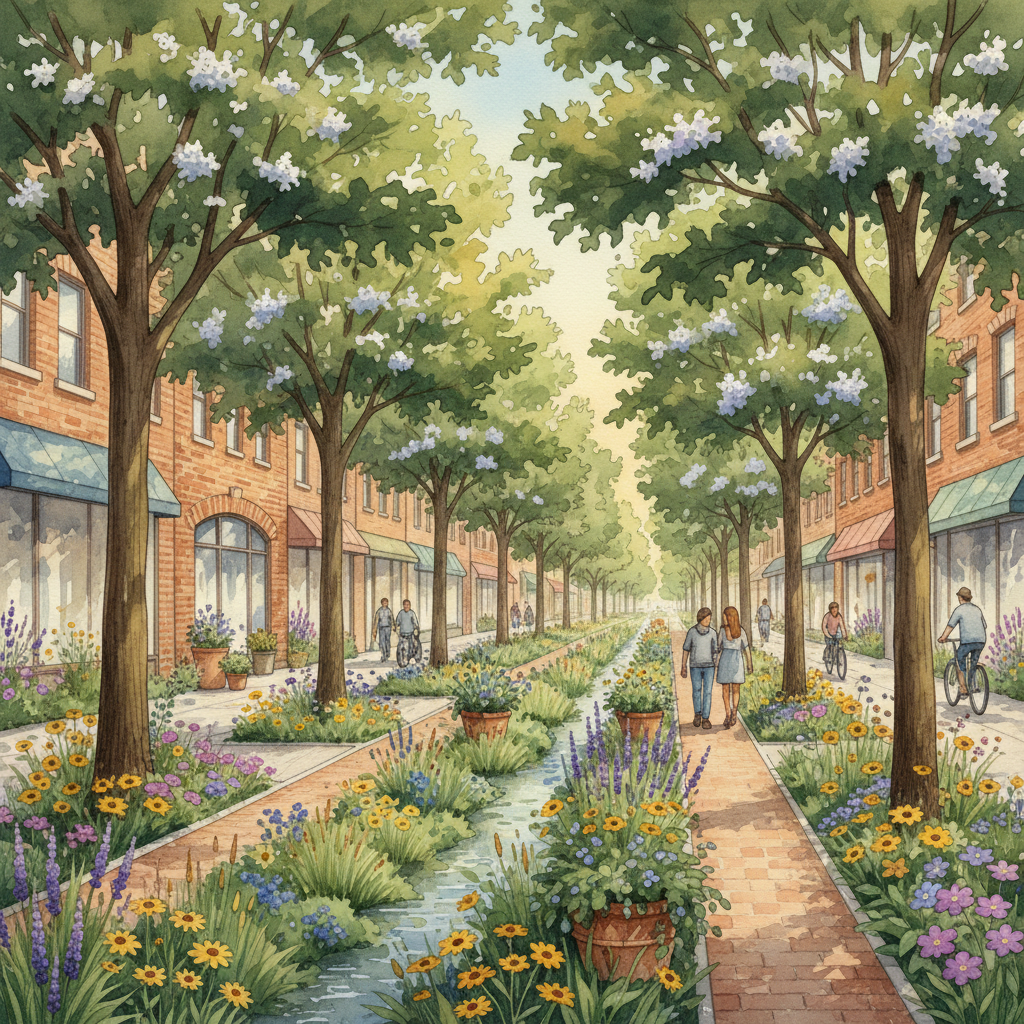
The Street as Infrastructure: Rethinking the Public Right-of-Way
The street is the most democratic space we have. It belongs to everyone — the child on a bicycle, the elderly neighbor walking to the corner store, the delivery driver, the dog, the rain. And yet for most of the twentieth century, we designed streets almost exclusively for one user: the automobile.
The consequences of that choice are everywhere. Streets that drain water as fast as possible into overtaxed storm systems. Corridors that divide neighborhoods rather than connect them. Public rights-of-way that are hostile to the very life they were meant to serve.
But something is shifting. Cities across the country — and across the Driftless — are beginning to ask a different question: what if the street could do more than move cars?
The answer, it turns out, is quite a lot. A street designed with bioswales and rain gardens can absorb and filter stormwater on-site, reducing runoff and recharging groundwater. A street with a tree canopy can reduce surface temperatures by ten degrees or more, cutting energy costs and making walking bearable in July. A street with a protected bike lane and a widened sidewalk becomes a place where people linger, where small businesses thrive, where neighbors actually meet each other.
This is not a utopian vision. It is engineering and landscape architecture working together toward a more honest accounting of what streets are for.
The public right-of-way is typically the largest single category of public land in any municipality — often thirty to sixty percent of total land area. That is an extraordinary resource. The question is whether we are willing to use it well.
In the Driftless, where karst topography makes stormwater management both critical and complex, the street-as-living-system is not just a design preference. It is a practical necessity. Every impervious surface we add to a watershed is a decision with downstream consequences — sometimes literally, for the cold-water streams and spring-fed rivers that define this landscape.
The good news is that the tools exist. The knowledge exists. What is needed now is the civic will to demand streets that serve the whole community — and the whole watershed — rather than just the commute.